Chess and the Law

Introduction

Have you ever considered how the strategies and tactics employed in chess might find their place in the intricate world of legal practice? Just as chess players rely on time-tested strategies to outmaneuver their opponents, legal professionals can also draw valuable insights from chess to navigate complex legal challenges.

Chess and law, seemingly disparate fields, share profound similarities. The strategic depth and tactical precision of chess can offer valuable tools for legal professionals. Exploring these connections shows how the mental discipline and decision-making skills honed on the chessboard can carry over to legal practice.

Mental Patterns

Mental patterns are cognitive frameworks shaped by cues, routines, and rewards. They help individuals process information efficiently and make decisions based on established patterns of behavior. In both chess and law, these mental patterns enable practitioners to anticipate moves, assess risks, and devise strategies with greater clarity and confidence.

Chess and Law: In chess, mental patterns guide players through well-established opening theories, allowing them to make informed decisions based on historical precedents and strategic insights. Similarly, in the legal field, mental patterns help attorneys navigate complex cases by relying on precedents and established legal principles. Both chess players and legal professionals benefit from the ability to quickly identify key patterns and apply them to their current situations, ultimately leading to more effective decision-making and strategic planning.

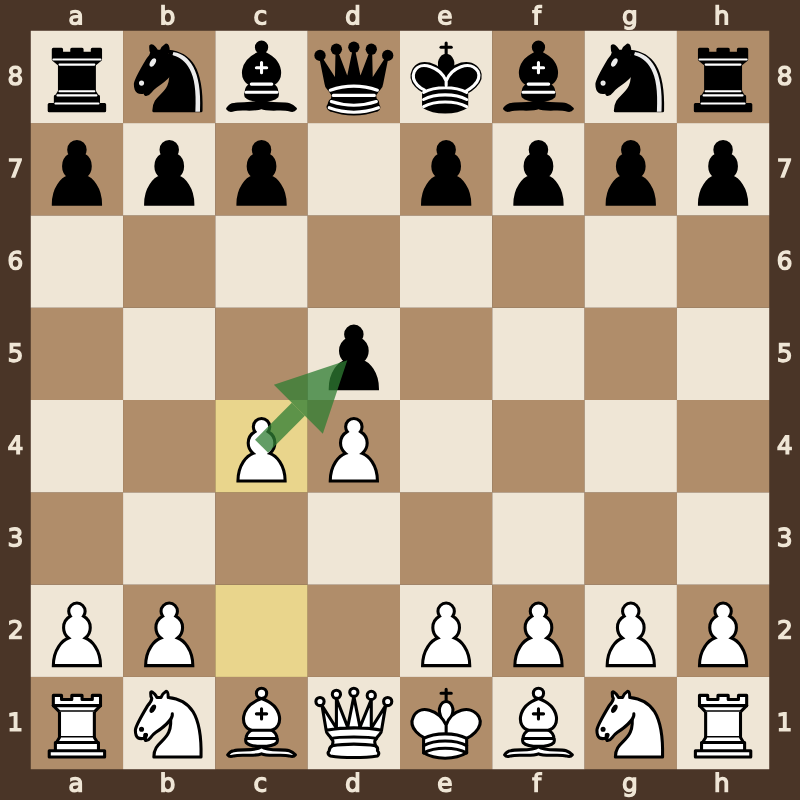
Chess diagram: the Queen’s Gambit after 1.d4 d5 2.c4, with an arrow from White’s c4 pawn to Black’s d5 pawn.
Opening theory. The Queen’s Gambit after 1.d4 d5 2.c4. White offers the c-pawn to draw Black’s d-pawn away from the center. Players meet this position with generations of published analysis behind them, much as attorneys meet a recurring issue with precedent behind them.

Chess and Legal Strategy

Notes on what the strategic depth of chess can teach about legal practice.

Chess Strategies

Controlling the Center:

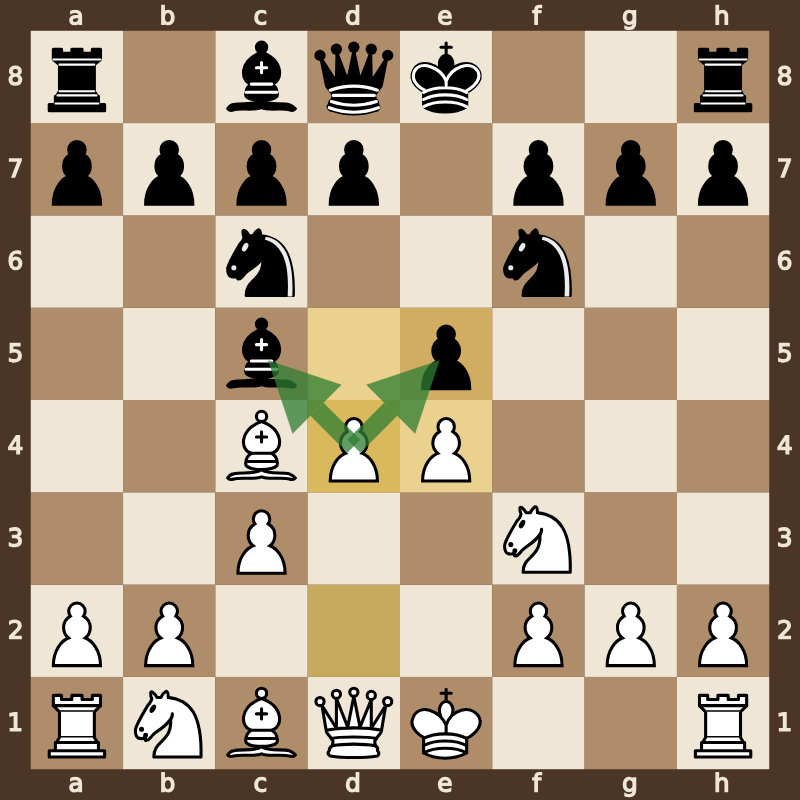
In chess, controlling the center of the board is crucial. It allows for greater piece mobility and influence over the game, setting the stage for both offense and defense. This strategic principle is akin to focusing on central issues and key legal principles in law. By establishing a strong presence in the center, chess players can dictate the flow of the game and create opportunities for future moves.

Chess diagram: Italian Game after 5.d4, with the four center squares shaded and arrows from White’s d4 pawn to e5 and c5.
Controlling the center. Italian Game after 1.e4 e5 2.Nf3 Nc6 3.Bc4 Bc5 4.c3 Nf6 5.d4. White prepared d4 with c3 and now has pawns on e4 and d4. The four center squares are shaded; the pawn on d4 attacks both the e5 pawn and the bishop on c5.

Developing Pieces:

Early development of chess pieces is essential for setting up a strong position. Similarly, in legal practice, early preparation, including gathering evidence and formulating arguments, is vital. Just as a chess player aims to develop their pieces effectively, a legal professional must build a solid foundation for their case by preparing thoroughly and positioning their arguments strategically.

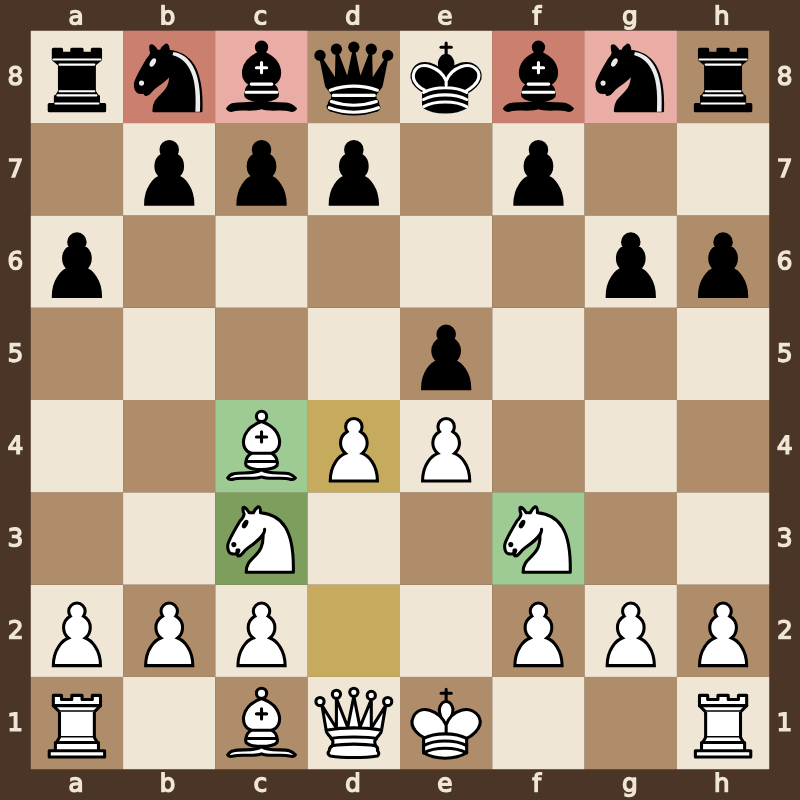
Chess diagram after 5.d4: White’s developed knights and bishop shaded green; Black’s undeveloped knights and bishops shaded red.
Developing pieces. After 1.e4 e5 2.Nf3 h6 3.Bc4 a6 4.Nc3 g6 5.d4, White has brought out three pieces (shaded green) and is opening the center. Black has made only pawn moves; its knights and bishops are still on their starting squares (shaded red).

King Safety:

Protecting the king is a fundamental aspect of chess strategy. In legal practice, this translates to avoiding pitfalls that could jeopardize a case. Just as a chess player takes measures to ensure their king’s safety, attorneys must be vigilant about safeguarding their case from potential risks and ensuring all aspects are carefully managed to avoid detrimental outcomes.

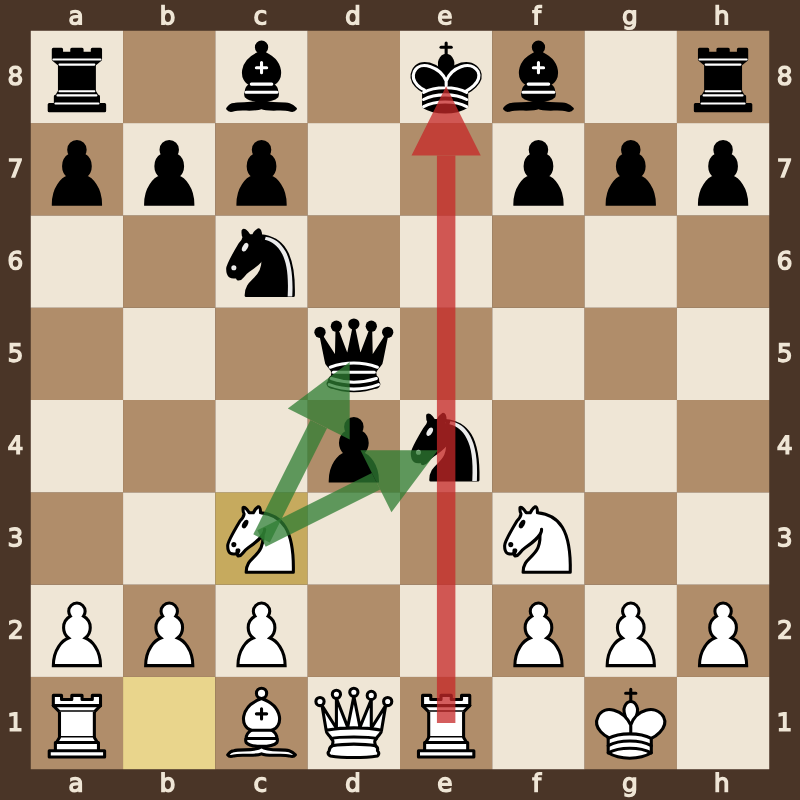
Chess diagram: Two Knights Defense after 8.Nc3, with an arrow along the open e-file from White’s rook on e1 to Black’s king on e8.
King safety. Two Knights Defense after 1.e4 e5 2.Nf3 Nc6 3.Bc4 Nf6 4.d4 exd4 5.O-O Nxe4 6.Re1 d5 7.Bxd5 Qxd5 8.Nc3. White’s king has castled. Black’s king is still in the center, the e-file is open, and the knight on e4 is pinned to the king by the rook on e1. White’s knight on c3 attacks both the queen and the pinned knight, so Black’s next move must answer the threat to the queen.

Tactics

Forks, Pins, Skewers, and Zugzwangs:

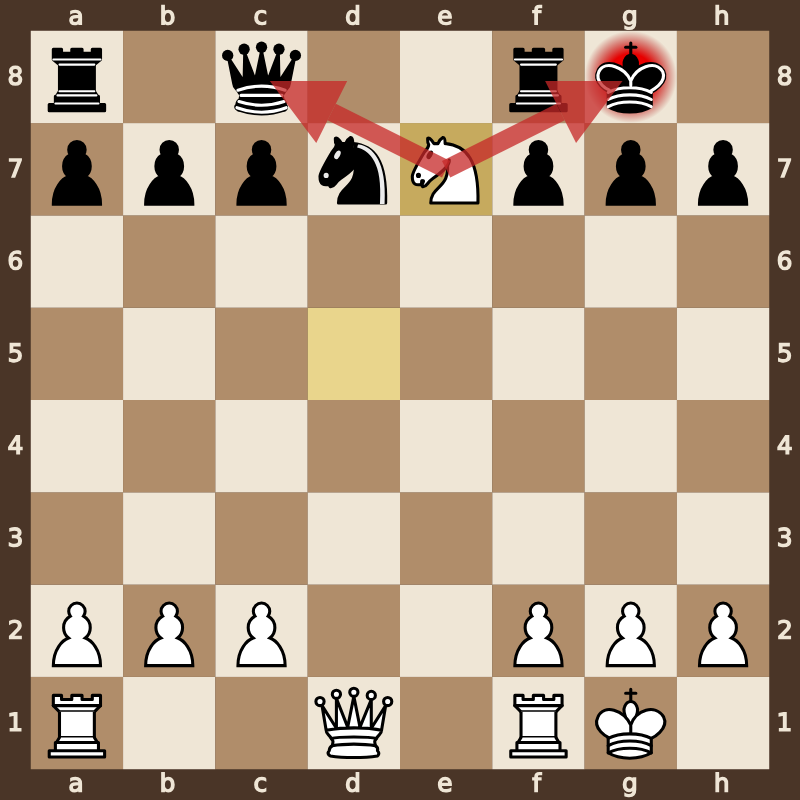
Chess diagram: a White knight on e7 checks the king on g8 and attacks the queen on c8.
Fork. White has just played Ne7+. The knight checks the king on g8 and attacks the queen on c8 at the same time. Black’s only legal reply is ...Kh8, and White then captures the queen.

Forks: In chess, a fork is a tactic where a single piece attacks multiple targets simultaneously. This can be likened to legal scenarios where a strategy addresses multiple legal issues or arguments at once. For example, a lawyer might use a single line of questioning to challenge several points of a witness’s testimony.

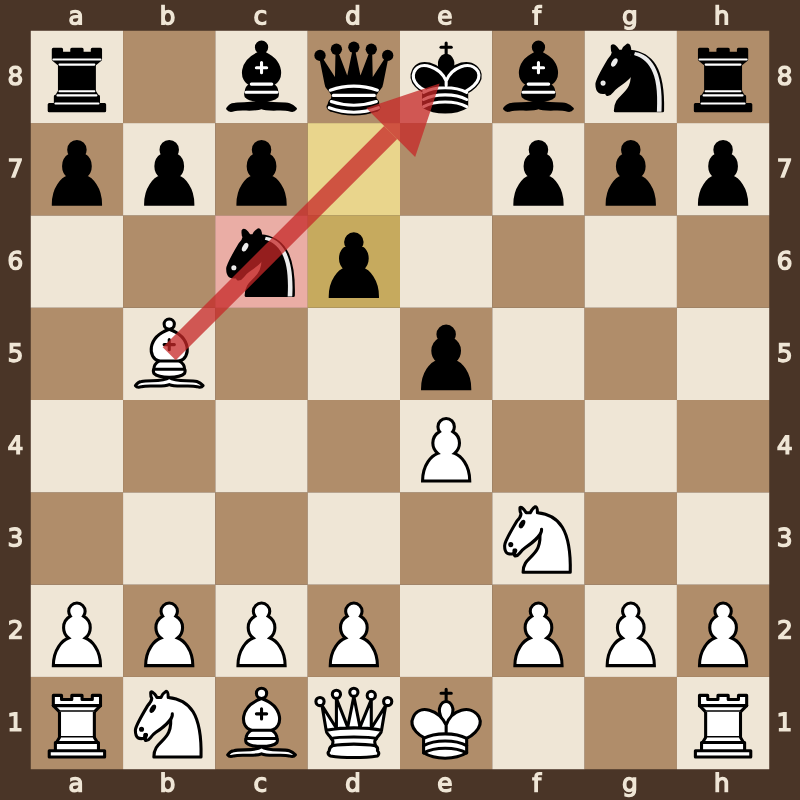
Chess diagram: Ruy Lopez after 3...d6; the White bishop on b5 pins the Black knight on c6 to the king on e8.
Pin. Ruy Lopez after 1.e4 e5 2.Nf3 Nc6 3.Bb5 d6. The knight on c6 stands between the bishop on b5 and the king on e8. Moving it would expose the king, so the knight cannot legally move: it is pinned.

Pins: A pin occurs when a piece cannot move because doing so would expose a more valuable piece behind it. In legal practice, this is similar to situations where certain arguments or evidence are strategically positioned to constrain the opposing side’s options, forcing them into a disadvantageous position.

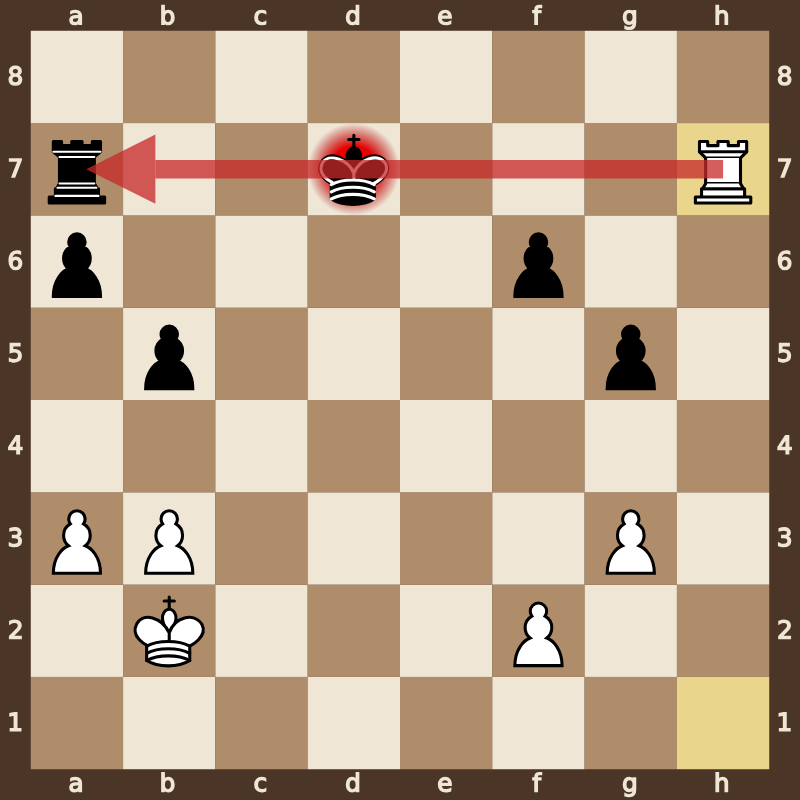
Chess diagram: a White rook on h7 checks the king on d7, with the Black rook on a7 behind it on the same rank.
Skewer. White has just played Rh7+. The rook checks the king on d7 along the seventh rank. The king must step off that rank, and the rook on a7, lined up behind it, is then captured.

Skewers: A skewer is the reverse of a pin: a valuable piece is attacked along a line, and when it moves out of the way, a less valuable piece behind it is exposed to capture. This tactic is analogous to legal strategies where a key argument or piece of evidence forces a reconsideration of broader legal issues, potentially impacting other areas of the case.

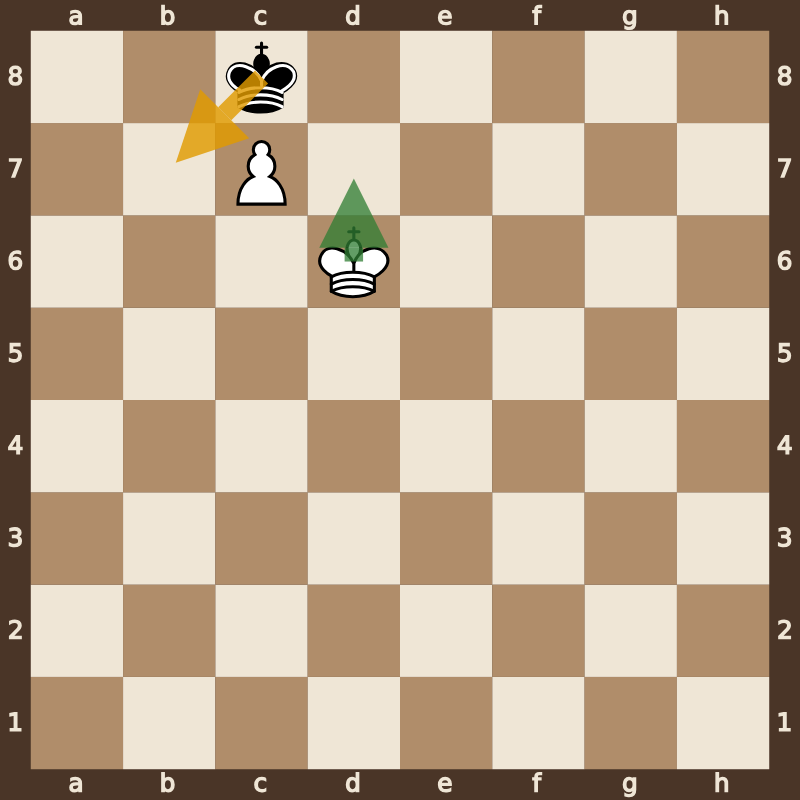
Chess diagram: White king on d6 and pawn on c7, Black king on c8, Black to move.
Zugzwang. Black to move. Black’s only legal move is ...Kb7, after which Kd7 takes control of c8 and the pawn promotes. With White to move instead, White could not win: Kc6 would be stalemate, and every other king move lets Black capture the pawn.

Zugzwangs: A zugzwang refers to a situation where any legal move worsens a player’s position. In legal terms, this can be seen in scenarios where any action taken by the opposing party only exacerbates their disadvantage, creating a “damned if you do, damned if you don’t” situation.

Examples:

Real-world legal examples of these tactics include:

  • Forks: A cross-examination strategy that simultaneously challenges multiple aspects of a witness’s testimony.
  • Pins: Legal arguments that strategically force the opposing side to concede certain points or narrow their focus.
  • Skewers: Using a pivotal legal decision to expose weaknesses in previous rulings or arguments.
  • Zugzwangs: Negotiation tactics that compel the opposing party into a position where their options are all unfavorable.

How an attorney can apply these ideas

These ideas are useful only when they are applied deliberately. The steps below show how an attorney can put each of them to work in an ordinary matter.

Assess the position before moving. Before choosing a plan, a chess player takes stock of material, king safety, and the structure of the position. At the outset of a matter, an attorney can do the same: identify the elements of each claim and defense, who bears the burden on each, the governing standard, and the controlling authority. Every later decision rests on that assessment.

Control the center. Identify the two or three issues on which the matter will actually turn, and direct discovery, motion practice, and witness preparation toward them. Arguments that do not bear on those issues tend to dilute the ones that do.

Develop before attacking. Bring every resource into play before the decisive moment: preserve the evidence, calendar every deadline, gather the documents, retain experts early, and settle the theory of the case. A motion filed before that groundwork is done is an attack made with undeveloped pieces.

Keep the king safe. The client’s position is the king. Guard against the exposures that can end a matter regardless of its merits: a missed deadline, a waived privilege, lost evidence, an unpreserved objection, or a position that will not survive scrutiny.

Look for forks. Before drafting a question, a request, or a filing, ask whether it can serve more than one purpose: a deposition question that both establishes an element and tests credibility, or a motion that both narrows the issues and frames the evidence for trial.

Use pins. Commit the opposing side to its positions early, through requests for admission, interrogatory answers, and deposition testimony. A party that has committed to a fact on the record cannot easily move away from it later without cost.

Watch for skewers. Press the most important point first. When the other side moves to protect it, a weaker position behind it is often left exposed. The same test applies in reverse: an attorney can ask whether the client’s strongest point, once attacked, would expose something behind it.

Create zugzwang where the rules allow it. Structure the choices so that each option open to the other side carries a cost: a well-timed settlement offer, a narrowly drawn request for admission, or a motion that requires the opposing party either to concede a point or to come forward with evidence it may not have.

Calculate, then commit. For each candidate course of action, consider the other side’s best response, not its most convenient one, and choose the line that still holds after that response.

Review the game afterward. Chess players study their finished games to find the moments where the result turned. Reviewing a closed matter the same way (what worked, what did not, and why) builds the pattern recognition described at the top of this page.
Altiorem’s approach

Altiorem brings the same habits of mind to its drafting: anticipating the opposing argument, weighing each move before it is made, and building each document toward a clear objective.

Conclusion

In summary, chess and law share many similarities in strategy and tactics. Attorneys may find chess-inspired habits of mind useful in their own practice.

Altiorem drafts legal documents for attorneys. To discuss a drafting project, contact Altiorem.